"Homesickness came with the years"
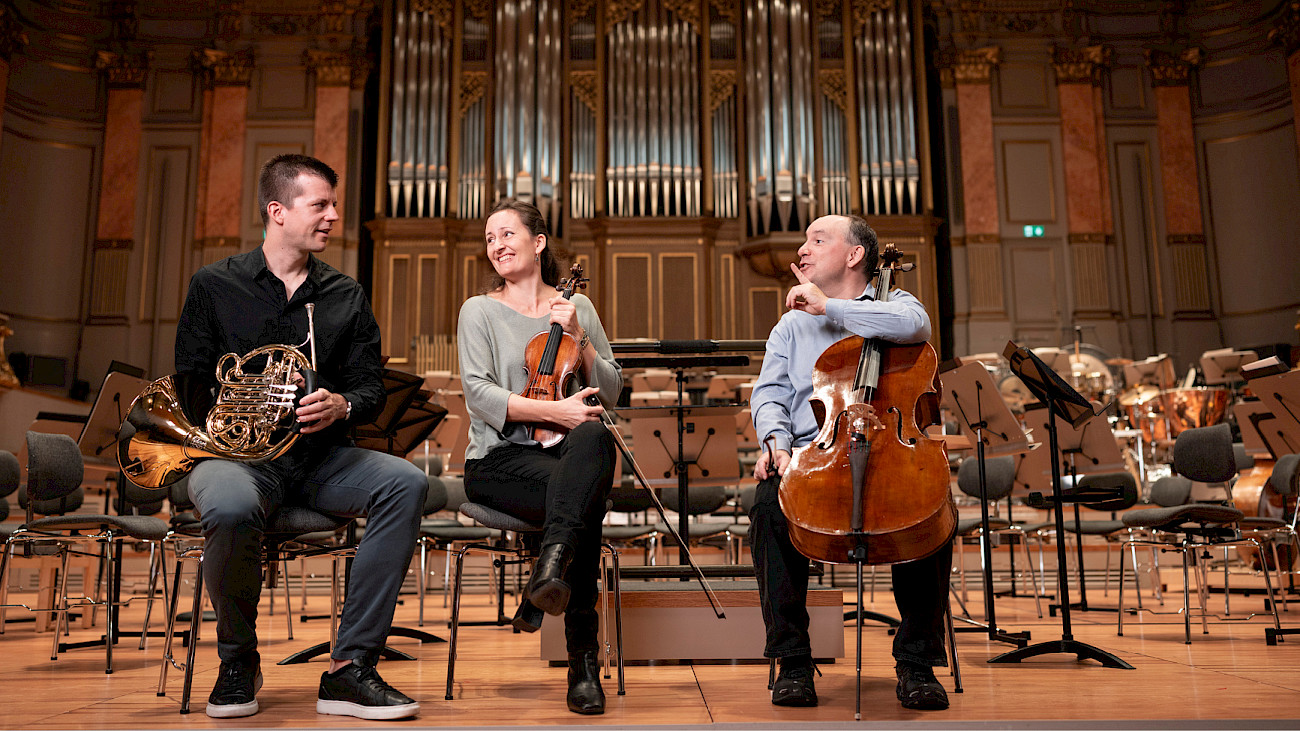
Around a quarter of the orchestra members come from Switzerland. Three of them talk about their move back home and international orchestral life.
Let's start with a few statistics: Which language do you speak most often in everyday orchestral life?
Rafael Rosenfeld Maybe English? Or Swiss German?
Isabelle Weilbach-LambeletI mainly speak German and French. There are only four of us from French-speaking Switzerland in the orchestra, but with my colleagues from France, this language group is relatively large.
Tobias Huber For me, it's probably High German. But I also speak Swiss German a lot.
RR What strikes me is that it's no longer so easy for musicians from elsewhere to learn German in this orchestra. It used to be a matter of course because it was the main language. In the 1990s, some even consistently spoke Swiss German with the newcomers. When David Zinman became chief conductor, English became more important, today it is the universal language. For example, I usually speak English with French colleagues, even though I learnt French.
Around a quarter of the orchestra members come from Switzerland, making you the largest group. Do you play a role as a group in any way?
RR No.
TH Not even in the committees. On the orchestra board, for example, it's certainly an advantage if you can speak German well. But nationality is not relevant.
IWL I wouldn't have thought that there were so many of us from Switzerland. Maybe because almost nobody speaks Swiss German with me?
TH From my point of view, a quarter is not a lot. In Germany, for example, the proportion of "nationals" is usually much higher.
Perhaps Isabelle's impression also has something to do with the fact that the proportion of Swiss in the various registers is very different. It is high for the cello and horn, but not so much for the violins. Is that a coincidence?
TH There are already a lot of good brass players in Switzerland!
RR The cello also has a great tradition here. That has to do with formative figures like Claude Starck or Walter Grimmer. Today, our former solo cellist Thomas Grossenbacher is an important teacher for the younger generation. This Swiss lineage is very present in our register.
IWL Yes, you can hear that, you are very homogeneous! There is actually less of this tradition with the violins. I didn't study in Switzerland either, but in Hamburg and Munich.
"Many people say that classical music is old-fashioned. Then I always think: take a closer look at who's sitting there! Our internationality is anything but conservative."
Tobias Huber
A total of 23 nations are represented in the orchestra: How important is this international cosmos for you?
IWL Very important and very nice. I wouldn't want to play in a purely Swiss orchestra. Switzerland is so small that at some point you get thirsty for something different - that's why I left to study. The openness that I experience in our everyday life has a lot to do with this international line-up.
RR We are perhaps already in a bit of a bubble. For us, this mixed environment is a matter of course. It would be almost strange if it were otherwise.
TH But it's precisely this naturalness that I find essential. Many people say that classical music is old-fashioned. Then I always think: take a closer look at who's sitting there! The proportion of women is growing - and this internationality is anything but dusty and conservative. It's a huge collection of experiences and information that comes to the office every day. Of course, this influences the way you see the world.
Are there moments when you particularly appreciate this internationality?
TH On tour! There are people in every city who grew up, studied or worked there.
IWL They always have insider tips, they know what you can do and, above all, where the food is good.
RR Conversely, we always find it a bit difficult to come up with insider tips in Zurich. If you want to eat something good here, it quickly becomes expensive.
TH We often go to the Sternen Grill with guest musicians ...
IWL I've just realised that we've never had a raclette evening with the orchestra. Maybe we should plan one?
While we're on the subject of national specialities: There's a cliché that says that although the broad education in Switzerland is very good, special talents are not really encouraged. What experiences have you had in this regard?
RR I was lucky that my parents were musicians, they already knew how and where. So everything was pretty straightforward. Without such a background, it can be more difficult to find the right path for a talented child. The Swiss tendency towards levelling is still noticeable here and there, but there are also very good offers.
IWL I attended Tibor Varga's violin school in Sion, where I received very targeted support - but it was, to a certain extent, outside the local school system. There were only a few of us from Switzerland.
RR The school here is very demanding. It's no coincidence that none of the Swiss solo cellists in the Tonhalle-Orchester Zürich have a Matura. Most of us started at grammar school, but at some point we had to make a decision. It's different in Germany, where the Abitur is more feasible.
IWL I don't have a school-leaving certificate either. Tibor Varga told me at some point: "Mademoiselle, if you want to be something, you have to step on the gas now. Practise a lot more, four hours a day for a few months, technique and etudes." Three days later, I was deregistered from school. My teachers thought I was crazy, but it was the right decision. For example, I was able to play a lot of chamber music - that would never have been possible alongside school. What also helped me a lot along the way were the scholarships I received: There are many generous foundations in Switzerland, which is hugely important for young talent.
TH It's different for us horn players than for string players, we don't have to practise so much so early on. If you work seriously for an hour, you can achieve a lot, that's all you need at the age of 15 or 16. That's why I did my A-levels as normal. It wasn't until relatively late that I realised I wanted to go to music college. From today's perspective, I think it was good that I had so much freedom for so long to broaden my horizons. For example, I also attended jazz school back then. I then completed my studies in Lucerne and Basel, and there was nothing that was missing. That only came later.
When then?
TH In Swiss orchestras, there are very few opportunities for young musicians - especially wind players - to gain orchestral experience. That's where the leap abroad comes in. I was in Munich with the Bavarian Radio Symphony Orchestra, where there is a very well-developed orchestra academy where you receive comprehensive support for two years and are familiarised with orchestral operations. That was a very intensive, exciting and formative time.

"My student days in Hamburg were brilliant at first, everything was open. But over the years I got homesick and realised that I missed this and that too."
Isabelle Weilbach-Lambelet
You all studied in Germany for a while and/or played in orchestras. Why did you come back?
IWL I hadn't actually planned it. But during my studies in Hamburg, I heard many orchestras, including ours with David Zinman. I really liked the energy in this concert and I always thought: if I ever play in an orchestra, I'd love to play in this one. But the fact that it actually turned out that way was a coincidence.
TH I was in Germany for over ten years in total, and after my time in Munich I had a permanent position with the Essen Philharmonic. The only thing that could lure me back was actually my current position. But I'd had my eye on it since 2005, I looked around and said to myself: when this musician retires, this is the job I want. 14 years later, the corresponding audition took place.
Planning for the eye of a needle ...
TH Yes! In hindsight, of course, it's funny, but there were a few ups and downs along the way, you never know how it's going to turn out.
RR I joined the orchestra at the age of 22, while I was still studying in Lübeck. Thomas Grossenbacher called me back then and asked if I would like to give it a try. There were two reasons why it worked out so quickly: I found a position very early on that I liked much better than I would have thought. But I still took a break for a while later because I wanted to see other things.
But you wouldn't have wanted to switch to another orchestra?
RR No. During my studies in Germany, I realised how much I liked living in Switzerland. I hadn't realised that before. I like the reliability here, that things work, that the streets are clean, that it's beautiful, both in terms of the landscape and in the cities. And also that I know the mentality well: even if we are not so many "locals", we still have a way of dealing with each other that I am very familiar with - and that I have never encountered anywhere else as a temp in other orchestras.
IWL I had a very similar experience. My time in Hamburg was brilliant at first, it was so interesting, everything was open. But over the years I got homesick and realised that I missed this and that. At some point it became clear that I wouldn't stay in Hamburg, that I would be drawn southwards, at least a little. When I was an academic in Munich, people always said on sunny days: Look at the mountains! And I thought: Where, please? We are already very spoilt in Switzerland. You become demanding.
Not everyone can afford this: most of your colleagues live far away from home. How far would you have gone? Would you have accepted a job in Tokyo, Bucharest or Buenos Aires?
RR Most likely the latter ...
TH I didn't become a musician to stay here. You have to be prepared to go out, comfort can't take centre stage. But the fact that I now have the opportunity to play at the highest level and also have this quality of life, I feel incredibly lucky.
"In the area of education, the Swiss tendency towards levelling is still noticeable here and there; but there are also very good offers."
Rafael Rosenfeld
IWL We have all come a long way and undergone demanding training. You can only do that if you love music and your instrument and are prepared to sacrifice a lot. I probably wouldn't have gone to Japan to join an orchestra, even though the country fascinates me. But I'm sure many of us would give up things in order to be musically fulfilled.
RR The question is what you need to be fulfilled. I recently spent a long time in the USA with my family - I wouldn't want to live there or play in an orchestra. The standard is extremely high, but the culture is very different. I have the feeling that the passion, the personal and chamber music aspects of our orchestra are particularly pronounced.
IWL And the fun! I have also experienced a very high standard in Germany. The sense of community is perhaps even more pronounced there than here, there are more people from the same musical school. Here in Zurich, we have very different personalities. But that's precisely why we are very open with each other and everyone gives their all: that's what makes our orchestra so special.
TH Perhaps this has something to do with the fact that Switzerland is a heterogeneous construct in itself? That requires a certain openness from the outset. I really appreciate the fact that you don't have to bend here, you're not forced into a strict tradition and can therefore really play with enthusiasm.
How much does the climate in the orchestra have to do with the general conditions? These are more stable in Switzerland than elsewhere, and then you also play in a beautiful hall ...
TH I don't think that the number on my salary slip has much influence on how I play. But the hall is very important. It's like an instrument for the orchestra, it shapes the way we all imagine the sound. If I compare it with other venues, we really have it very good.
RR The working conditions are important. It is much more difficult to make music with body, soul and concentration if you are overworked or there are too few rehearsals, for example.
TH But it's not the case that Switzerland is the promised land for everyone. A number of people from my degree programme are still abroad, they like being there and have great jobs. It's not just Zurich.
IWL But we definitely have it good here. The people who do an internship with us are always happy to stay.
So everything is fine? Or do you have any wishes for Swiss music life?
RR My biggest wish is international: I think it's a shame that more or less the same soloists play everywhere. It's incredibly difficult for young people to get a chance. Of course, the theatres have to fill their halls, but personally I would find more variety more interesting.
IWL I would like to see the smaller theatres and concert organisers maintain their diversity. Many have suffered greatly during the coronavirus period and it is important that they continue to be properly nurtured, supported and appreciated. The closeness between audience and artists in small theatres is a special experience. I think it would be a real shame if at some point there were only the big festivals and organisers.
TH That is also the most important point for me. We have such a diverse cultural life - that's not a given when you look at other countries. As far as I'm concerned, it could all become much more permeable, there is still too much divisional thinking and thick walls here and there that could be dismantled. But many good initiatives are being launched, including here. Something like the collaboration between our orchestra and the Zurich Jazz Orchestra at tonhalleAIR last summer, for example: that opened up horizons for both sides.