"I'm amazed myself right now"
Muzzano and Engelberg, Ittingen Charterhouse and, time and again, the Tonhalle Zurich: several key moments in the career of pianist Kirill Gerstein took place in Switzerland.
Kirill Gerstein was born in 1979 in Voronezh, Russia, emigrated to the USA at the age of 14, has now lived in Berlin for a long time - and says after a few minutes on the phone: "I'm amazed at how much of my life is connected to Switzerland."
The first connection, back then in Ticino, was also a telephone call. As a teenager and student at Berklee College of Music in Boston, Kirill Gerstein called the Bulgarian pianist Alexis Weissenberg, who lived in Muzzano near Lugano: "I told him that I would like to play for him. He just asked: Why?" The answer - that he was fascinated by Weissenberg's recordings, especially those of Bach's Partita No. 4 - must have been convincing, and Gerstein received an invitation to Muzzano. "Weissenberg was very nice, we played for a whole day, talked and played again. In the end, he asked me to attend his masterclasses at Engelberg Abbey."
The young pianist then travelled to these courses twice, where he met the Zurich banker Nicolas de Buman, among others - and through him Mischa Damev, who was the director of the Orpheum Foundation at the time. This Zurich-based foundation supports young soloists by enabling them to perform with leading orchestras. Kirill Gerstein says that Damev promised him one such performance, "but young musicians are promised many things and usually nothing comes of it". In this case, it was different: on 23 September 2000, at the age of 21, he played Brahms' Piano Concerto No. 1 in the Tonhalle Zurich under the direction of David Zinman.
Is it fair to say that this concert marked the beginning of his career? "Yes, yes," says Gerstein. He had performed here and there before, "but never with such a good orchestra". The collaboration with David Zinman, the beautiful hall, "that was an exhilarating experience for me". And not only Alexis Weissenberg was sitting in the audience, but also an agent who offered him his first management contract: "That's how it all started slowly."
Jazz or classical music?
The emphasis is on "slowly". Kirill Gerstein is glad that his career didn't explode "from zero to one hundred", "it all happened step by step". This meant he wasn't caught off guard by events, but was able to steer them, which in his case meant avoiding artistic motorways and finding his own path.
He had always done that. For a long time, it was unclear whether he would be drawn towards jazz or classical music. And when he decided in favour of classical music because of its immense repertoire, this in no way meant the end of his love of jazz: the joy of improvisation, experimentation and discovery remained, as did his aversion to the all-too-obvious and superficial. After another performance at the Tonhalle, where he played Rachmaninov's Piano Concerto No. 3 a year after his momentous debut, a Zurich critic concluded his extremely positive review with a sentence that had almost prophetic qualities: "Let's hope that he can make a career without grand gestures and gimmicks."
To this day, Gerstein prefers to leave grand gestures and gimmicks to others. A bit of show is part of it, he says, "there's no denying that". The crucial thing is to remain authentic, "Honesty is important, both in life and on stage. I would be allergic to doing something just because others expect it of me". This is another reason why he has never signed an exclusive contract with a major label: "With my creative restlessness, it makes more sense to reconsider who the right partners are each time."
Bruno Ganz's last recording
He very often found these partners on the small label Myrios Classics, which has released numerous Gerstein recordings. They are perhaps less visible here than on a larger label, he says, "but I have a lot of creative freedom". He showed how he knows how to utilise this with four-hand Mozart works, for example, for which he was able to motivate his long-time mentor, the legendary Hungarian pedagogue Ferenc Rados, to make one of his rare appearances. Or with the double album "Music in Time of War", which contains works by Debussy and the Armenian composer Komitas from the time of the First World War - and a booklet with detailed essays that not only place this music historically, but also reflect on the present.
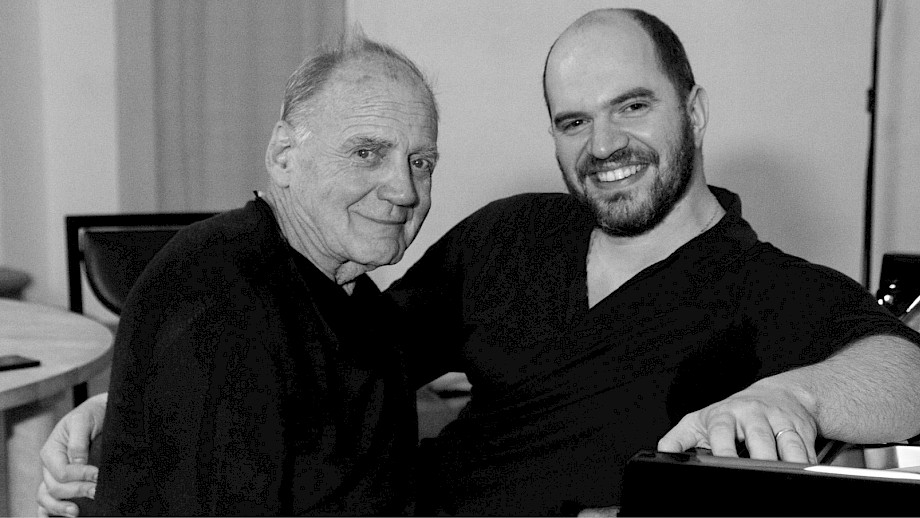
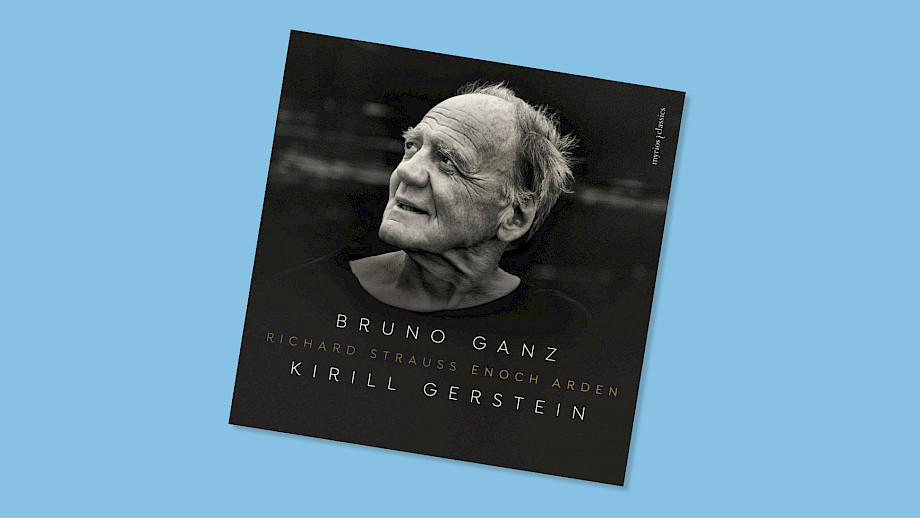
And then there is Richard Strauss' melodrama "Enoch Arden", based on a ballad by Alfred Tennyson, for which the pianist collaborated with one of the most popular Swiss actors ever: Bruno Ganz. They met in 2011 at the Ittingen Whitsun Concerts, and Ganz initially reacted cautiously to Gerstein's suggestion that they perform this work together: He couldn't read music.

From then on, a correspondence developed between the two, "with a lot of humour and self-irony". Gerstein kept asking questions and Ganz kept asking for patience: he was either involved in a theatre project or had to recover from a theatre project. This went on for around two years, until one day the photographer Ruth Walz, the actor's partner, called: Bruno Ganz had now read and heard about the play and really wanted to do it, "when can you come?".
The rehearsals took place at the Tonhalle Zurich, and Kirill Gerstein was impressed by how concentrated they were: "We were in the theatre for eight hours, and I don't remember him ever getting up." Ganz had already analysed two different translations of Tennyson's ballad beforehand, thinking about Strauss' cuts and where the text might need to be amended. They later toured with the play, "the demand was very high, we did around 40 performances". And they made further plans: they would have liked to work on Viktor Ullmann's melodrama "Die Weise von Liebe und Tod des Cornets Christoph Rilke", which was sketched in the Theresienstadt concentration camp. But Bruno Ganz died in 2019 and the recording of "Enoch Arden" was his last. He misses him, says Gerstein, "he was a special person, very talented, very warm, very honest. We became close friends during our performances together".
A "well-rounded career"
He also usually talks about people when he talks about his projects. Chick Corea, for example, from whom he ordered a piece with the prize money from the Gilmore Artist Award. Of his jazz teacher, the great vibraphonist Gary Burton, with whom he premiered Corea's "The Visitors". Or from Manfred Eicher, the label founder of ECM Records, to whom he offered a recording discovered by chance on his computer several years later: "Eicher once brought Burton and Corea together, so ECM was the only possible partner for this recording." Incidentally, this was also a last one: Gary Burton ended his career some time ago, "but he was very happy about this unexpected addition to his discography".
The name Thomas Adès comes up particularly often in conversation: the British composer, conductor and pianist, who is shaping the programmes of the Tonhalle Orchestra Zurich this season as Creative Chair, has been a close companion of Kirill Gerstein for twenty years. He can be heard as the second pianist on the aforementioned CD "Music in Time of War" and has also often worked with Gerstein as a conductor. Above all, however, he wrote a piano concerto for him in 2018, which the two of them will perform for the first time in Zurich in June - and which is one of the "grand gestures" that have been made in this pianist's career. The piece is a success; he has now performed it around eighty times and the recording has been released by Deutsche Grammophon.
There is no doubt that Gerstein is a "musician's musician", someone who seeks and needs dialogue with allies - and takes on very different roles to do so. In the past, this was a matter of course, he says, "people like Liszt or Chopin played concerts, composed, taught, it was all connected". He also pursues a "well-rounded career"; he doesn't like the word concert pianist, he sees himself as a musician in general, as someone who performs, launches projects, doesn't compose but improvises - and has been teaching for many years.
From Havana to Zurich
It is normal for him "to be a teacher and student at the same time". He regularly travelled to see Ferenc Rados until his death in February 2025. At the same time, various of his students have since fledged: Mao Fujita, for example, with whom he recently travelled through Japan on a duo tour - and whom Zurich audiences were also able to get to know last season.
When Gerstein himself returns to the Tonhalle Zurich as the focal artist, something will once again come full circle. Various memories are likely to come flooding back, not only of the start of his career and the rehearsals with Bruno Ganz, but also of a completely unexpected performance two and a half years ago. He was on holiday in Havana at the time, "I was visiting a museum when my agent called to ask if I could rehearse and play the Gershwin concerto in Zurich the next day, as Igor Levit had been cancelled due to illness". He was able to. And he also remembers this concert as a delightful experience: "Sometimes you can breathe easily with an orchestra - and this was one such evening."