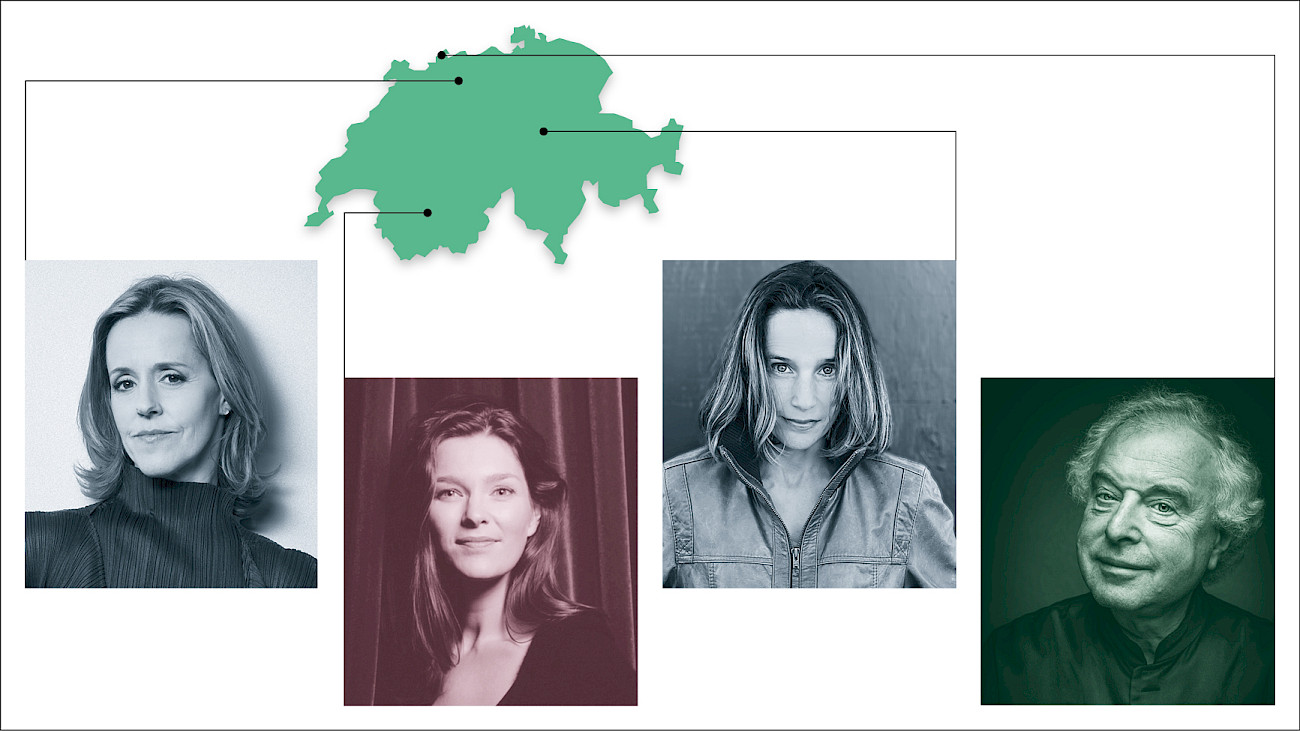
Fotos: Kaupo Kikkas, Marco Borggreve, Mat Hennek, Nadja Sjoestroem
Adopted home Switzerland

"I have a Swiss head"

What do Sol Gabetta, Janine Jansen, Hélène Grimaud and András Schiff have in common? They will soon be performing with the Tonhalle-Orchester Zürich. And: they live or have lived in Switzerland.

Susanne Kübler

When Richard Wagner travelled to Switzerland on 28 May 1849, he did not exactly do so voluntarily. He was wanted for his involvement in the Dresden May Uprising ("37 - 38 years old, of medium build, with brown hair and wearing glasses"). Switzerland was to be the first stage of his escape to Paris; to cross the border at Rorschach, he had obtained the passport of a Tübingen scholar and practised his Swabian dialect. As he travelled "in the mail coach through the friendly St. Gallen countryside", he was delighted by the natural surroundings. Three days later he arrived in Zurich, saw "the Glarus Alps bordering the lake for the first time in brilliant sunlight" and decided to "avoid everything that could prevent me from settling here". At any rate, this is how he described the start of his artistically and amorously fruitful time in Switzerland in his autobiography "My Life".

After him, many musicians came to Switzerland for a certain period of time or for good, for a wide variety of reasons. Brahms spent several summers in Zurich and the surrounding area - and inaugurated the Tonhalle as conductor in 1895. The composer Bohuslav Martinů settled first in Basel and later in Pratteln as a guest of patron Paul Sacher, Igor Stravinsky found inspiration and collaboration with Charles Ramuz in Clarens and Morges, and conductors Bernard Haitink and Herbert Blomstedt were drawn to Lake Lucerne, as was the Russian exile Sergei Rachmaninov decades earlier. Among the soloists performing in the coming months are four who have chosen to make their permanent or temporary home in Switzerland: Sol Gabetta, Janine Jansen, Hélène Grimaud and András Schiff.

Sol Gabetta - Olsberg

Nature and an old farmhouse lured her to the smallest municipality in the canton of Aargau, Sol Gabetta once told the NZZ. It had been a long journey to get here, even for someone who was used to travelling long distances as a child: she travelled eight and a half hours with her father to Buenos Aires for cello lessons. She later received a scholarship in Madrid and then studied in Basel with Ivan Monighetti. From there to Olsberg was only a stone's throw away.

Switzerland suited her well, she told Paavo Järvi as they drove through Zurich together for the "Tram for Two" video series, "I needed a structure. And the way I lived here gave me everything I was looking for". He asked whether she had a Swiss soul, and the answer came in a flash: "A Swiss head!"

Sol Gabetta also made her international breakthrough in Switzerland; at the age of 23, she made her debut with the Vienna Philharmonic at the Lucerne Festival as the winner of the Credit Suisse Young Artist Award. Just one year later, she founded the Solsberg Festival in Olsberg. During all her international travels, she dreamed of "making music next door to my home: just leave my own four walls, walk over, play and come home again". Since then, the little village with its imposing monastery church has become a place of pilgrimage for chamber music fans every summer.

But of course, a soloist's life in Olsberg alone would not be possible. Since the last edition of her festival, Sol Gabetta has performed in Vail, Vienna and Warsaw, among other places. However, she is always trying to shorten her radius, with performances in Basel, Freiburg im Breisgau and Gstaad. And this season she is also a focal artist with the Tonhalle-Orchester Zürich: the journey home to Olsberg takes considerably less time than it once did to her cello lessons.

Janine Jansen - Sion

Unlike Sol Gabetta, violinist Janine Jansen already knew Switzerland, or more precisely Valais, as a child. Every summer, her family travelled from the Netherlands by caravan to the campsite in Vissoie in Val d'Anniviers, as she recounted in an interview: "I grew up in this area and later returned there often because of the clean air and the magnificent landscape." She was also in Sion occasionally back then. It was these memories that led her, who could undoubtedly have taught anywhere in the world, to take up her first position as a professor at the Hému in 2019 - at the Sion branch of the Haute École de Musique.

Since then, she has officially lived with her husband and dog in Valais, in a village above Sion. She feels "not exactly at home here, but at home", she said on her last visit to Zurich; "a quiet place in nature is exactly what I need". She gave up her position at Hému last summer; she has also been teaching at the renowned Kronberg Academy in the Taunus for two years, and two professorships were one too many. Instead, she has taken over the co-directorship of the Sion Festival, which was once founded by the Hungarian Swiss by choice Tibor Varga: she has had carte blanche for concert programmes there for years and now shapes the festival together with her Ukrainian colleague Pavel Vernikov.

At the last edition in summer 2025, she played Felix Mendelssohn Bartholdy's String Quartet No. 6, which he had begun on his last trip to Switzerland.

Hélène Grimaud - Weggis

French pianist Hélène Grimaud had actually discovered the USA as her adopted home early on. But in 2005 she performed at the Lucerne Festival and liked the villages around Lake Lucerne so much that she bought a house in Weggis and her first Steinway together with the photographer Mat Hennek. She lived here for around ten years when she wasn't on tour: she once said that she was often barely at home for two nights a month.

In 2011, she described the importance of this place in the Financial Times: Weggis was great for recharging your batteries, "you can feel the energy that the mountains radiate". She talked about the sunrise, hours of walks with her dog Chico, bread and cheese and raw vegetables: "On tour, I'm constantly eating in restaurants or from room service, so it's nice to be able to just eat." Sometimes she went to the cinema in Lucerne, where she saw "Avatar", for example. And sometimes to a concert: after a recital by Maurizio Pollini, she was "so inspired and energised that I immediately changed the programme of my planned CD".

By 2016, Hélène Grimaud's Swiss interlude was over. The restaurants in Weggis that she liked now have different names ("Oliv" and "Hyg" respectively). But her agenda still includes regular Swiss appointments.

Sir András Schiff - Basel

András Schiff is an international traveller: he was born in Hungary, later acquired German and British citizenship (as well as the title of "Sir") - and has lived not only in Florence and London, but also in Basel for several decades. He came here as a young pianist through the concert agent Pio Chesini. And the older he gets, the more comfortable he feels in the city, he said in an interview with former NZZ features editor Martin Meyer in the volume "Musik kommt aus der Stille" - although this "also has to do with security issues".

However, he has left his mark (outside of the large concert halls) in another corner of Switzerland in particular: at the Ittingen Charterhouse near Frauenfeld. There he founded the Ittingen Whitsun Concerts in 1995 together with another Basel resident by choice, the composer, oboist and conductor Heinz Holliger. "In the footsteps of Bach into the 21st century" was the motto of the first edition, which already indicated how smoothly Schiff and Holliger complemented each other in their programme ideas. The old was reflected in the contemporary, trouvailles in eternal values and vice versa. Schiff stepped down as artistic director of the Whitsun Concerts in 2013, but he is still represented by Hochuli Konzert AG, based in Gais, Appenzell, which has organised the festival since its inception.

As a pianist, Sir András Schiff has remained present at many venues in Switzerland since his retirement from Ittingen. He appreciates the Swiss audience, especially in the Tonhalle Zurich, which is "not only knowledgeable, but also extremely quiet and disciplined", he wrote in the aforementioned volume. In the last few months alone, he has performed in Lucerne, Ascona and St. Gallen. For his debut as conductor of the Tonhalle-Orchester Zürich, he has included works by two composers on the programme who themselves had a close connection to Basel: both Witold Lutosławski and Béla Bartók were supported by Paul Sacher. Schiff will also conduct concerts by Beethoven and Bach from a grand piano that once belonged to conductor Sir Georg Solti.

Solti also had many connections with Switzerland and the Tonhalle-Orchester Zürich. But that's another story - which we tell on the following pages.

January 2026
Wed 14. Jan
19.30

Sir András Schiff with Bach and Beethoven

Tonhalle-Orchester Zürich, Sir András Schiff Leitung, Klavier Bach, Beethoven, Lutosławski, Bartók
Thu 15. Jan
19.30

Sir András Schiff with Bach and Beethoven

Tonhalle-Orchester Zürich, Sir András Schiff Leitung, Klavier Bach, Beethoven, Lutosławski, Bartók
Sat 17. Jan
18.30

Piano recital: András Schiff

Sir András Schiff Klavier, Schaghajegh Nosrati Klavier (Contrapunctus XIII) Bach
Fri 30. Jan
19.30

Paavo Järvi & Hélène Grimaud

Tonhalle-Orchester Zürich, Paavo Järvi Music Director, Hélène Grimaud Klavier Janáček, Gershwin, Sibelius
Sat 31. Jan
18.30

Paavo Järvi & Hélène Grimaud

Tonhalle-Orchester Zürich, Paavo Järvi Music Director, Hélène Grimaud Klavier Janáček, Gershwin, Sibelius
February
Sun 01. Feb
17.00

Paavo Järvi & Hélène Grimaud

Tonhalle-Orchester Zürich, Paavo Järvi Music Director, Hélène Grimaud Klavier Janáček, Gershwin, Sibelius
Wed 25. Feb
19.30

Jaap van Zweden & Sol Gabetta

Tonhalle-Orchester Zürich, Jaap van Zweden Leitung, Sol Gabetta Violoncello Lalo, Bruckner
Thu 26. Feb
19.30

Jaap van Zweden & Sol Gabetta

Tonhalle-Orchester Zürich, Jaap van Zweden Leitung, Sol Gabetta Violoncello Lalo, Bruckner
March
Wed 11. Mar
19.30

Paavo Järvi & Janine Jansen

Tonhalle-Orchester Zürich, Paavo Järvi Music Director, Janine Jansen Violine Adès, Brahms, Mendelssohn Bartholdy
Thu 12. Mar
19.30

Paavo Järvi & Janine Jansen

Tonhalle-Orchester Zürich, Paavo Järvi Music Director, Janine Jansen Violine Adès, Brahms, Mendelssohn Bartholdy
June
Sat 06. Jun
18.30

Andrés Orozco-Estrada & Sol Gabetta

Tonhalle-Orchester Zürich, Andrés Orozco-Estrada Leitung, Sol Gabetta Violoncello Strauss, Martinů, Tschaikowsky
Sun 07. Jun
17.00

Andrés Orozco-Estrada & Sol Gabetta

Tonhalle-Orchester Zürich, Andrés Orozco-Estrada Leitung, Sol Gabetta Violoncello Strauss, Martinů, Tschaikowsky
Mon 08. Jun
19.30

Sol Gabetta & Cello Ensemble

Sol Gabetta Violoncello, Celloensemble des Tonhalle-Orchesters Zürich, Paul Handschke Violoncello im Ensemble, Anita Leuzinger Violoncello im Ensemble, Rafael Rosenfeld Violoncello im Ensemble, Sasha Neustroev Violoncello im Ensemble, Benjamin Nyffenegger Violoncello im Ensemble, Christian Proske Violoncello im Ensemble, Gabriele Ardizzone Violoncello, Anita Federli-Rutz Violoncello im Ensemble, Ioana Geangalau-Donoukaras Violoncello im Ensemble, Sandro Meszaros Violoncello im Ensemble, Andreas Sami Violoncello im Ensemble, Mattia Zappa Violoncello im Ensemble, Floriane Bonanni Konzept
published: 12.01.2026

Tags