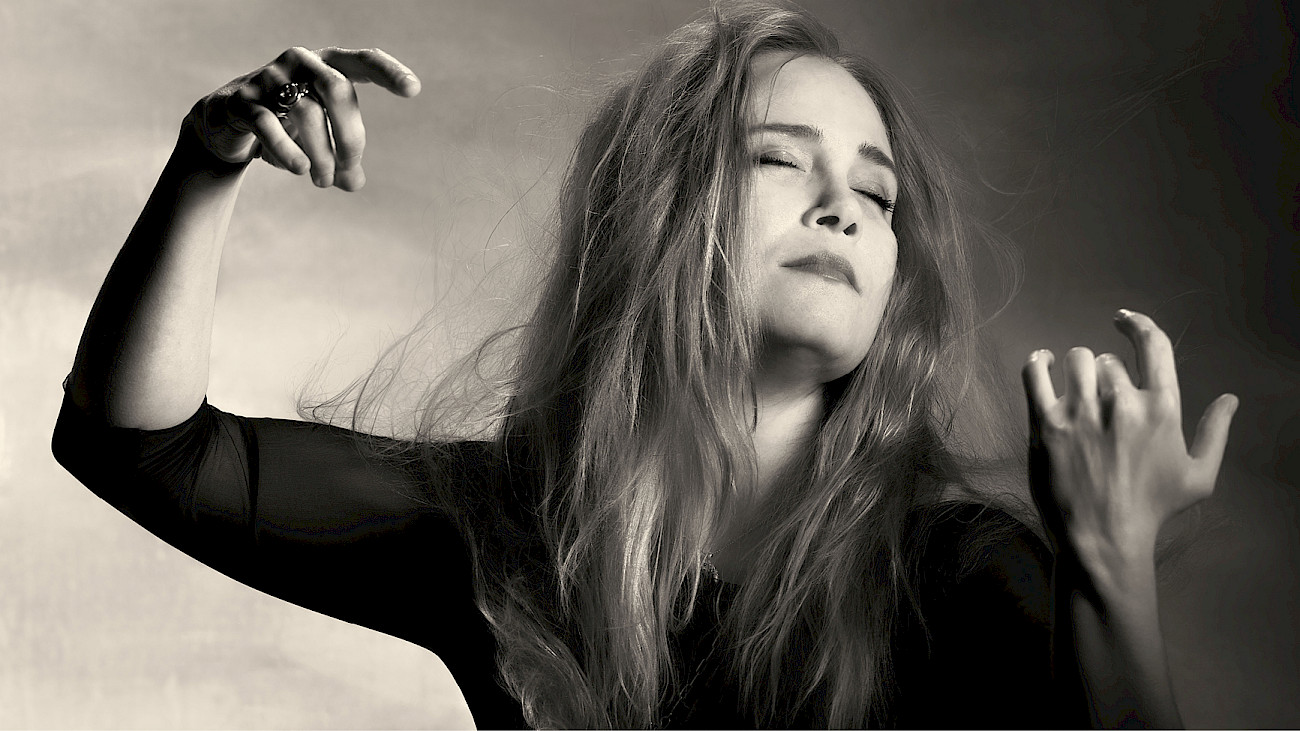
If anyone needs "a bold, exploratory, thinking, dancing and spectacularly virtuosic soloist", then Leila Josefowicz, born in 1977, is just the right person, according to the Los Angeles Times. Now, ahead of her Zurich performance of Thomas Adès' violin concerto "Concentric Paths", is a good time to take a closer look at these adjectives.
Courageous
Leila Josefowicz was three years old when her parents - her mother a geneticist, her father a physicist - gave her a violin. Soon she was performing as a child prodigy at parties in Hollywood and Beverly Hills, at the age of 10 she got her first big management contract and at 13 she began her studies at the renowned Curtis Institute of Music. She seemed to be perfectly set for a glamorous career - until she decided in her early 20s that she didn't want such a career: It all seemed too old-fashioned to her, too predictable. As soon as she had her diploma, she put the works of Beethoven & Co. to one side and decided to perform John Adams' violin concerto.
Exploratory
For her, these Adams performances really did represent a radical break with the past, especially because the composer heard one of her concertos and was so enthusiastic that he went on tour with her and this work as conductor. This first contact with a contemporary composer was a revelation, said Leila Josefowicz in an interview with the Finnish music journalist Jari Kallio in 2022: "Suddenly the music was alive and breathing, and this was the creator, and I was allowed to play with him. It was a completely different world that I entered." In this world, she has since worked with many other composers, inspired numerous works - and also rediscovered individual classics from a new perspective: Beethoven and Bach occasionally appear in her programmes, as do Stravinsky and Shostakovich. But her main focus remains on the recent present.
Thinking
Anyone who strays as far from the mainstream as Leila Josefowicz cannot rely on the tried and tested, but only on her own ideas, experiences and thoughts. She also needs a clear head during performances, all the more so as she plays everything by heart - including the Adès concerto "Concentric Paths", which she will present as part of the Zurich new music festival Sonic Matter. Although this work is complex in many respects, she says, "it is no more complex than the concertos by Beethoven, Brahms or Stravinsky". That's why she needs to be just as familiar with it as with these: "It's not okay not to know something very well just because it's new." She is so busy working on a piece that she hardly thinks about anything else during this time. She has to stay in it to find her way into a new musical language, she says: "Even when I go shopping, I have the score with me because I might need to look something up."
Dancing
Anyone who has ever experienced a performance with Leila Josefowicz knows what is meant: not large-scale gestures, but an inner attitude. There is nothing cerebral, nothing strained in her interpretations; she lets the sound flow and crumble, blaze and float, explode and seep away. Even the most complicated works do not sound like work, but like music.
Spectacularly virtuoso
Of course she is a virtuoso, there is no other way to master her repertoire. But her overview is at least as spectacular as her fingers, as conductor Hannu Lintu told us after a performance of "Concentric Paths": "We had some difficulties with the end of the first movement during preparation, where the solo part is interwoven with various interjections from the percussion section. And she simply reproduced everything from memory and showed me which instrument belonged where and how I should best rehearse it. That's when I really realised how deep her musical understanding really goes." This understanding doesn't come naturally to her, says John Adams: "She's not like Simon Rattle, who looks at something and masters it immediately. She has to work and work and work and work, note for note. But that's the kind of dedication she has." At this point, it is worth mentioning another adjective that is often mentioned in connection with Leila Josefowicz: fearless. Of course she has fears, she says in the aforementioned interview, "Performances are difficult". The important thing is to face these fears: "That's what makes great music possible - if you're prepared to fight!"