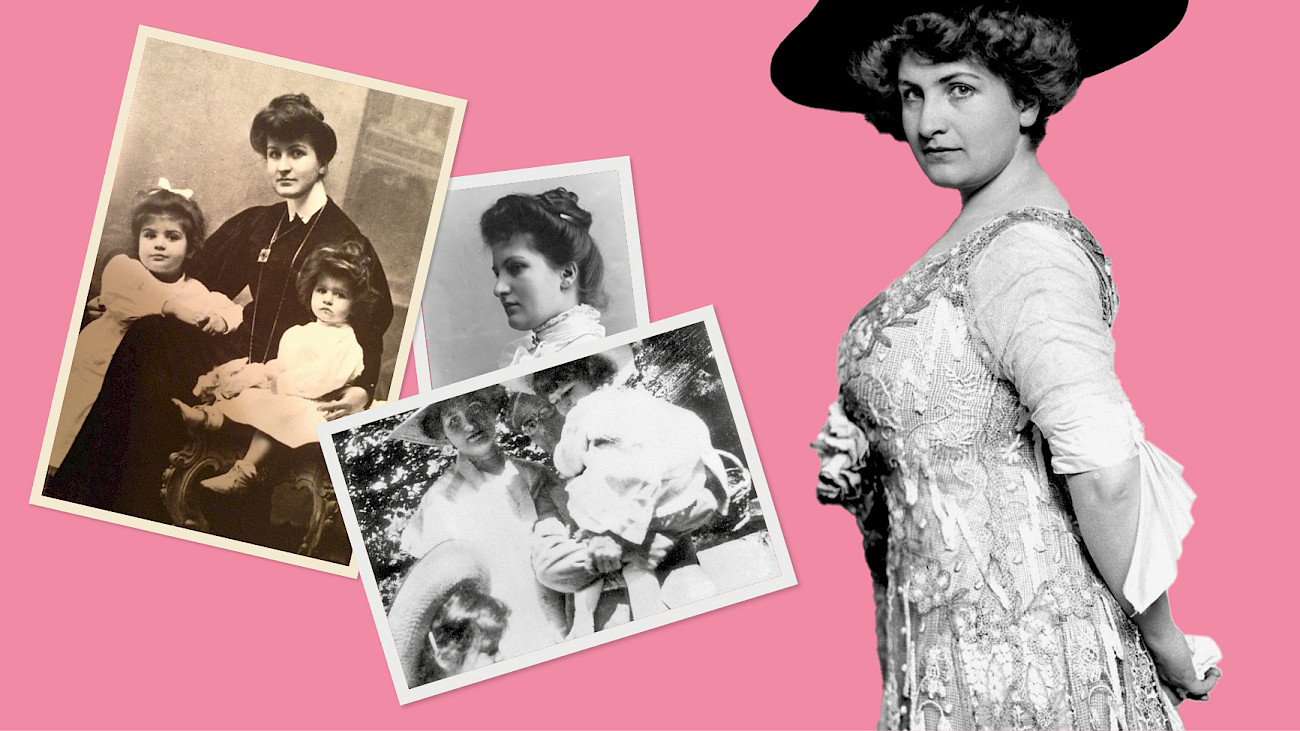
This woman was showered with titles: from the "most beautiful girl in Vienna" to the "indomitable muse" to the "widow in madness". And what a struggle she was subjected to for professional titles: Muse, salonnière, composer, of course wife and mother, widow, lover and even adulteress. She was all of these things - and yet she remains elusive. What is certain is that her influence on social life and numerous artists in her circle was immense. Alma, born Schindler in 1879, later (and widowed) Mahler, divorced Gropius, still later Werfel, commented on this fact herself in a letter to Willy Haas in 1962, two years before her death: "No one will succeed in describing me completely, not even I myself have succeeded. I am full of riddles that cannot be solved. In days to come, people will say of me: she was a sphinx."
"Passionate being"
The mysteriousness and ambivalences are also what have kept her present for so many decades. And, as can be surmised from her own statements, this was fuelled by self-dramatisation. While the so-called "diary suites" were not intended for the public at the beginning, in later years Alma deliberately shaped and reshaped her perception in society and thus also the later historical image of herself.
It is therefore all the more remarkable that Willy Haas' foreword to her autobiography "My Life" already mentions that her portrayals in it were toned down. Because: "Alma was and is a passionate being in her sympathies, but also in her antipathies. Some of the objects of her sympathy are still alive - as are those of her antipathy. She had made many clear-sighted judgements, but also some erroneous and dangerous ones."
This "huge compendium of great love and kindness, hatred, clairvoyance, blindness in one of the most important epochs of German intellectual life" reflects the ambivalences of the woman who, as a sharp-tongued anti-Semite, nevertheless married two Jewish men, who, despite great talent at the piano, did not intervene more strongly to force her to study, and who, despite promising beginnings in composing, only sporadically continued to do so after Mahler's death.
Mahler as a turning point
The first question marks regarding Gustav Mahler were already raised in her early diary entries. Within a few days and weeks, she oscillated between the most devoted admiration for the Vienna Court Opera director ("I think only of him, only of him", 28 November 1901) and almost physical rejection of a person who had "actually stood closer to her from afar" "than from close up": "I dread it" (diary entry, 3 December 1901). In addition, the following judgement was made from the outset: "I don't believe in him as a composer." This judgement weighed more heavily than she might have been able to assess before the wedding. For soon afterwards, Gustav Mahler was to extract a momentous concession from her with a view to the forthcoming marriage. In the legendary letter of 19 December 1901, he asked a question that Alma, who defined herself as a composer, had probably not expected - even though the conventions of the time were on his side: "Is it possible for you to consider my music as yours from now on?"
According to what she had previously noted in her diary, there could really only have been one option. She struggled the next day, speaking of an "eternal sting" that would remain: "My first thought was - write him off". Nevertheless, just two days after the letter, she wrote: "Yes - he's right - I have to live with him completely". In terms of form, then, this was not an explicit "ban on composing", as it later went down in history, but nevertheless an implicit one - and one that she lived by for long stretches. Even if Alma probably had a hand in Mahler's works more often than can be proven.
This meant that the compositional tailwind that Alma had felt immediately beforehand had evaporated. Alexander Zemlinsky had been largely responsible for the upswing: Having had composition lessons with Josef Labor since 1895 on the recommendation of her piano teacher, it was he who encouraged her to find her own style. The songs she composed were very much in keeping with the zeitgeist of the Viennese turn of the century between the end of Romanticism and Modernism.
Lost idyll
She used the lyrical pieces as a mouthpiece for her innermost feelings - such as "In meines Vaters Garten". In this song, she remembers her beloved father, who died young, and commemorates a lost idyll of her childhood. It is part of the collection "Fünf Lieder", which had already been composed around 1900/01, but disappeared from her composition portfolio due to her marriage to Mahler, until he himself recommended it for publication by Universal Edition in 1910. This about-turn can only be understood against the background of the marriage crisis: In the face of the loss of his wife to her lover Walter Gropius, he courted the composer.
This was followed by further "Four Songs" by Alma, the creation of which Mahler still supported favourably, but which were only published after his death. Significantly, a drawing by Oskar Kokoschka adorned the cover, with whom Alma was in a relationship around 1913, but who was unable to persuade her to marry him. Instead, she entered into a marriage with her former lover Walter Gropius: in 1915, in the midst of the First World War, Gropius was serving at the front. In the same year, Alma set Franz Werfel's "Der Erkennende" to music, which is at the centre of her third and last song cycle, published in 1925. It reads: "One thing I know: never and nothing will be mine. My only possession is to recognise that." The later husband thus perhaps came closer to Alma Mahler-Werfel's essence than many others before him - the essence of a woman who, despite being bound by convention, never allowed herself to be possessed.